What Is Organic Balloon Decor? Sizes, Shapes and Style Guide
Organic balloon decor explained: what the style is, how it differs from a classic spiral arch, the size layers that build it, and where it is used.
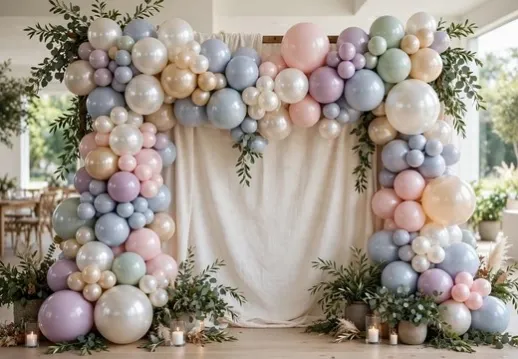
The short answer
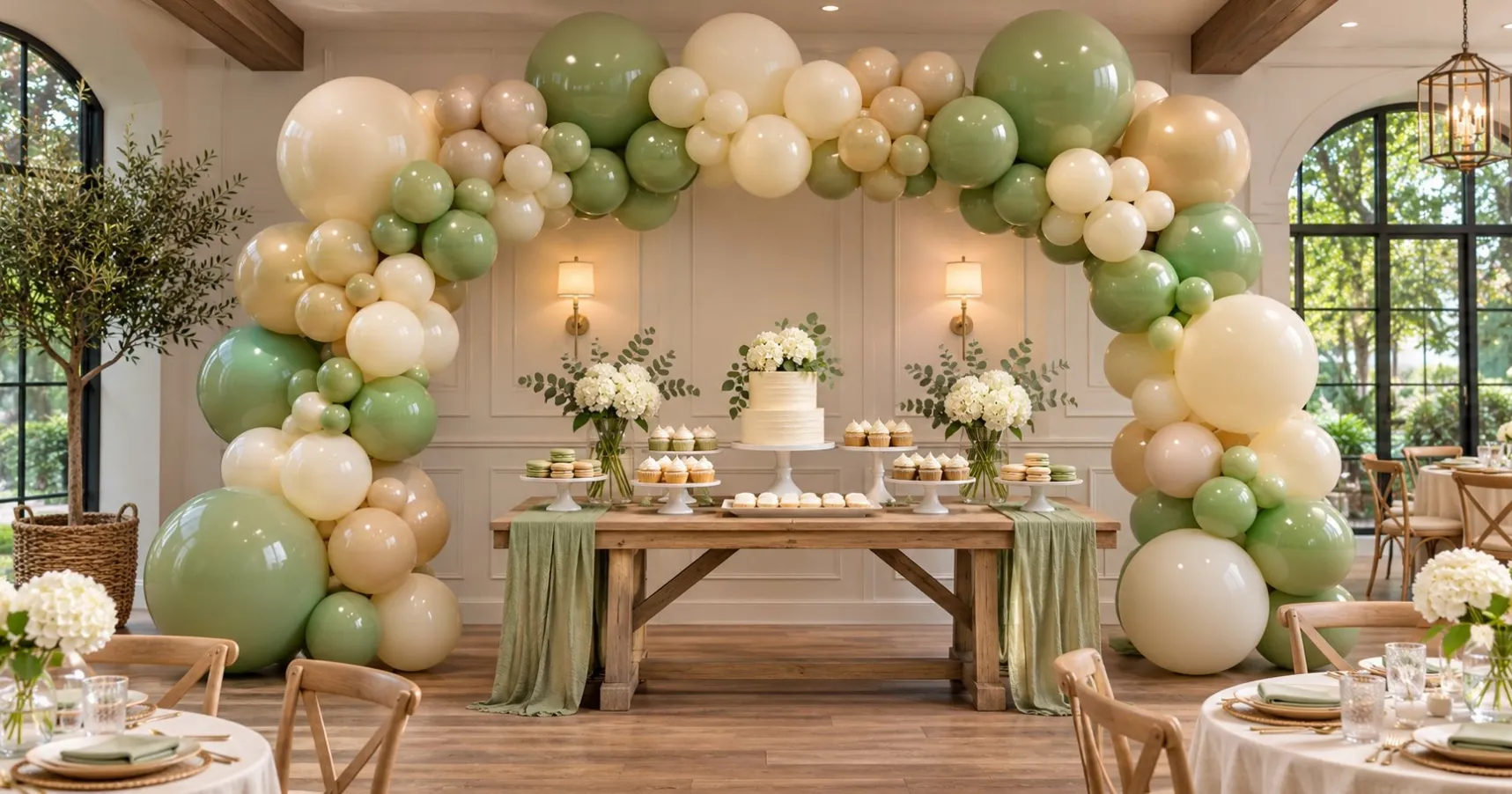
- Organic balloon decor is the free-form style: balloons arranged in flowing, uneven clusters, with no repeating pattern. No two installations are exactly alike.
- The variation comes from size: balloons inflated to different diameters, grouped so the surface rolls like a cloud. One nominal size used at several diameters can do it; several sizes can be combined too.
- It is the opposite of the classic spiral arch, where every cluster is the same size and the pattern repeats evenly from end to end.
- It suits weddings, baby showers, brand backdrops and photo walls — anywhere a soft, styled look beats a neat pattern.
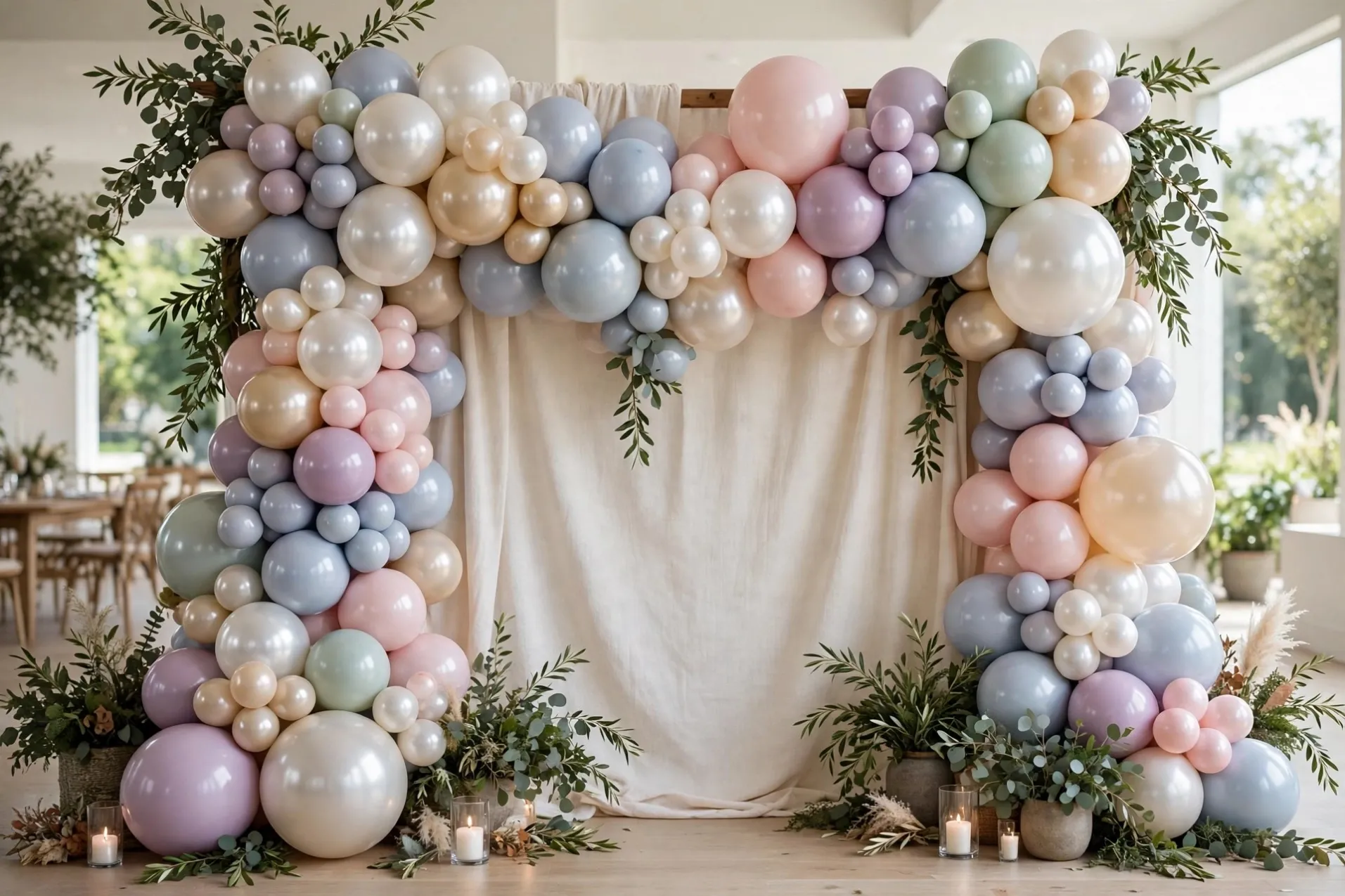
What "organic" actually means
The name comes from nature: an organic installation is built the way a vine grows — thicker in some places, trailing off in others.
Balloons are inflated to many different diameters and grouped in irregular clusters, so the decorator composes by eye.
The varied sizes catch the light differently across the piece, which is why organic work photographs so well.
Organic vs classic spiral
| Classic spiral | Organic | |
| Pattern | Repeating, even spiral | None — free-form |
| Balloon sizes | One size, evenly inflated | Sizes mixed, or one size at different diameters |
| Shape | Perfect arch, column or straight garland | Flowing, uneven, tapered ends |
| Build method | Cluster, rotate, repeat | Compose by eye, adjust as you go |
| Forgiveness | Low — one wrong size breaks the pattern | High — irregularity is the style |
| Best for | Entrances, columns, corporate patterns | Weddings, showers, backdrops, feature walls |
Neither style is "better." Spiral reads as tidy and deliberate; organic reads as lush and styled. Many events use both — spiral columns at the door, an organic garland on the photo wall.
One common recipe: three layers
The layers below are a building recipe, not a definition. A piece reads as organic because of its free-form outline and varied diameters — the layering is simply one reliable way to build it.
- Base layer — 10" and 12". The body of the piece. Clusters are inflated to different diameters — a 12" balloon at about 11", 9" or 7" — to create the rolling, cloud-like surface. A sizing box or template keeps the diameters consistent; the maker's stated size is the maximum, not a target to pass.
- Filler layer — 5". Small balloons finish the piece: tucked into gaps, clustered along the tapering ends, dotted where a color transition needs sharpening.
- Statement layer — 18". The focal points: a few large balloons at the base, the top corner and the widest swells, where the eye lands first — usually in the accent color.
A worked example, with counts that add up
Shares only mean something on a real piece, so here is one example in full: a medium garland about 3 meters (about 10 feet) long, built full, at roughly 120 balloons.
| Layer | Balloons | Share of the count |
| Base (10" and 12") | 84 | 70% |
| Fillers (5") | 30 | 25% |
| Statements (18") | 6 | 5% |
| Total | 120 | 100% |
Change the conditions and the counts move. A wider, fuller garland of the same length can take half as many again; a slim swag takes far fewer.
Inflation diameters move them too: smaller diameters mean more balloons for the same coverage. Treat the example as a starting point, and scale by the fullness you want. For framed arches, the balloon arch guide works through base totals by arch size.
How organic color behaves
- Shades of one family — light, mid and dark tones of the same hue mixed through the piece, so it shades the way a real plant or a cloud does.
- Mixed finishes — matte pastel for softness, pearl when the piece should glow under evening light, retro muted tones for rustic and boho settings.
- A 60/30/10 split by balloon count (main / secondary / accent) is a reliable starting point for a multi-color piece; the accent often sits in the 18" statement balloons.
- Custom layered colors — decorators sometimes inflate one balloon inside another to deepen or mute a shade; that double-stuffed technique has its own guide.
Shapes the style takes
- Garland swags — draped across backdrops, tables and mantelpieces
- Half-arches and full arches — framing backdrops and entrances, usually fuller on one side
- Balloon walls — a full textured surface built for photos
- Ceiling clouds — clustered overhead pieces for large rooms
- Table runners and centerpiece clusters — the same layered recipe at small scale
Stocking for organic work
Organic work consumes balloons across the size range in a single piece, so decorators and party-supply shops stock base sizes, a standing supply of 5" fillers, and a small reserve of 18" balloons in accent colors.
The DecorateBalloons ranges cover all three layers — standard latex (5", 7", 10", 12", 18", 36"), pastel (10", 12"), retro (10", 12", 18") and pearl (10", 12") — all bagged, with mixed orders, OEM and private label available.
With more than 20 years in the industry and exports to over 50 countries, we can also guide first-time importers through the process step by step.
Browse by finish: Standard latex balloons · Pastel latex balloons · Retro latex balloons · Pearl latex balloons
Planning a piece? Send a reference photo, the size of the space, where the piece will stand and the event date through our contact page — we will help you turn it into a size-and-quantity list before you order.
Frequently asked questions
Is organic balloon decor harder than a classic arch?
In one way it is easier: there is no pattern to keep perfect, so a slightly-off cluster disappears into the design. The real skill is composition — judging fullness and outline from the front.
A full organic garland usually takes more balloons than a slim spiral of the same length, and a light organic swag can take fewer. Length alone does not decide it — the volume and fullness do.
How many balloons does an organic garland need?
There is no honest per-meter rate: length, width, fullness and inflation diameters all move the count. Start from the worked example above — about 120 balloons for a full 3-meter garland — and scale by the fullness you want.
Can a single color look organic?
Yes. The effect comes from the varied diameters and the uneven outline, and both work in a single color and a single finish. If you want more depth, layering light, mid and dark shades of the family — or mixing two finishes — is an optional extra, not a requirement.
What is your MOQ for wholesale balloon orders?
We keep our minimum order low, and every inquiry gets a proper quote — asking costs nothing. Send us the sizes, colors and quantities you have in mind, and we will work out a quote for exactly that list.